How to Bowhunt Turkeys without a Ground Blind
For a next-level challenge, try run-and-gun turkey hunting with your bow in hand
Pop-up ground blinds are game-changers for bowhunting turkeys. They mask your draw from a gobbler’s sharp eyes and, most of the time, the blinds themselves don’t seem to put turkeys on alert. But blinds aren’t without their drawbacks. Being bound to a 5-foot by 5-foot piece of real estate is limiting—especially when there’s a tom hammering a few hundred yards away. It is possible to move a ground blind, but it’s cumbersome, time consuming, and causes a commotion.
For many long-time turkey hunters, the idea of being stuck in a ground blind removes the strategizing and setup elements that make turkey hunting so enjoyable in the first place. So, why not ditch the blind and follow the action? Bowhunting turkeys without a ground blind is certainly more challenging, but it has some advantages, too. Some hunters wouldn’t have it any other way. If you’re committing to the challenge this spring, here’s what to know.
CAMO UP
Hunting without a ground blind makes wearing head-to-toe camo critical. Wild turkeys have impeccable eyesight, and anything appearing unnatural will often send them away, alarm-putting to notify other turkeys of a potential threat. In addition to your jacket and pants, gloves and a face mask are non-negotiable. Many archery hunters go so far as to wear ghillie suits when bowhunting from outside of a blind.
GET A LITTLE CLOSER
Whether you’re closing in on a gobbler that has already evaded you or one that is roosted, try to creep within 100 yards or closer before setting up and calling. Although the right gobbler will respond and commit from much farther distances, getting within a tom’s bubble considerably increases the response rate.
BE A SETUP SNOB
Good setups are arguably the most important aspect of any style of turkey hunting, but especially bowhunting without a blind. Knowledge of the contours and cover on the property you’re hunting is priceless information that allows you to sneak into a good setup undetected. But once you’re in the zone, bowhunters should take a few extra steps to ensure the setup will work in their favor.
Select a position that provides front cover, background cover, or both. You don’t always have to be completely hidden, and you don’t have to be a magician to go unnoticed. But you do have to become one with a natural element such as a log, tree trunk, pine bough, hay bale or farm equipment in a way that disrupts your outline. Convincing decoys will also take the spotlight off you, which brings us to the next point.
BRING THE DECOYS
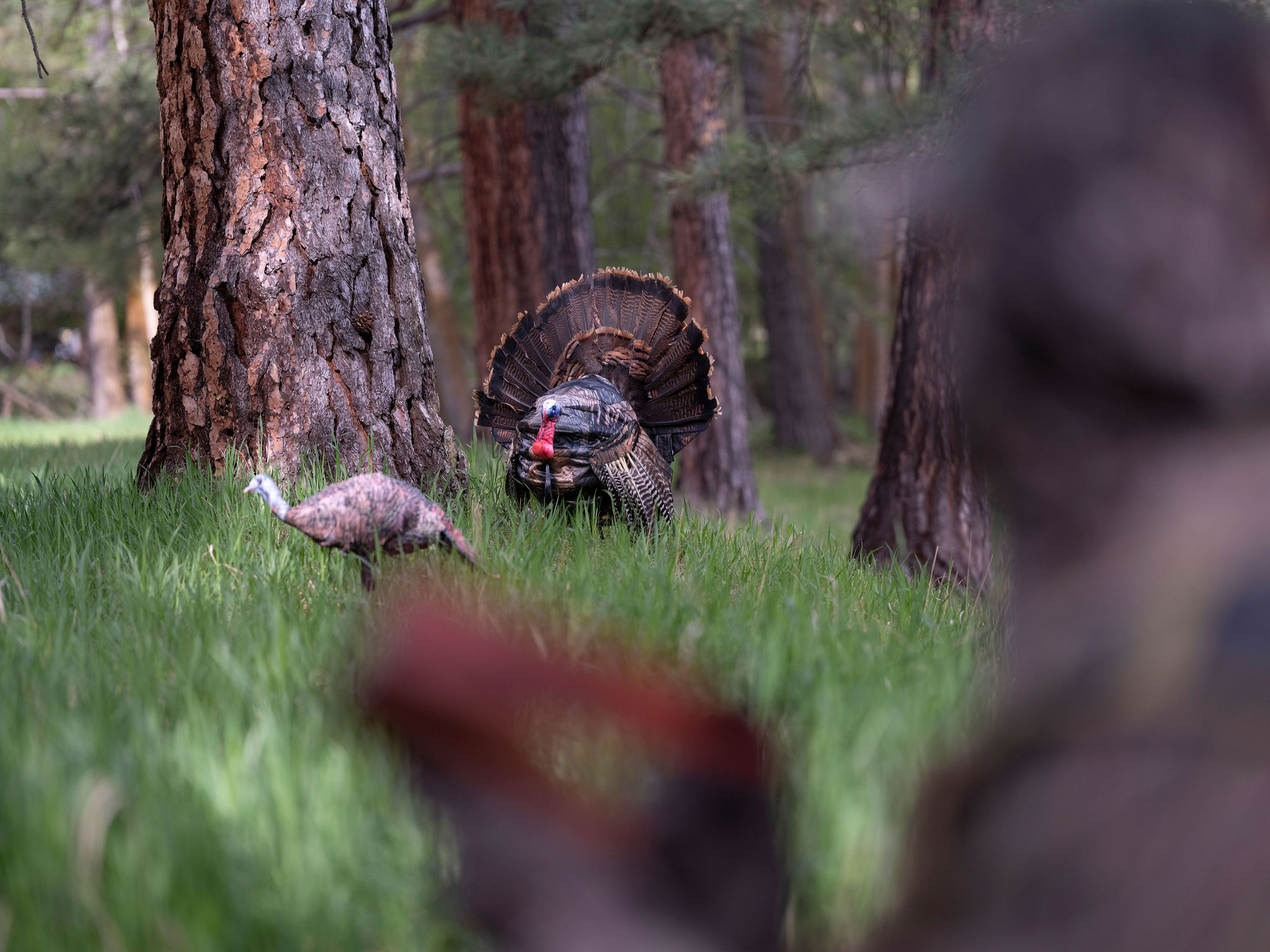
A jake or gobbler decoy plus a hen makes for a deadly decoy combo for bowhunting.
Sure, it’s technically possible to shoot a tom with a bow without a blind or decoys, just as it’s technically possible to catch a gobbler with your bare hands. But the truth is, decoys make the difference for bowhunters. It’s extremely difficult to pull a turkey into the open at 20 yards or less without a visual aid to distract its sharp eyes away from the source of the calling. Often, he’ll come close enough to see where the calling was coming from (which might be plenty good enough for a shotgun). But that’s not good enough for a bow shot. Turkeys have tiny kill zones, and you really need them inside 20 yards and occupied for the best opportunity.
Decoys, especially a jake or gobbler paired with a hen, help make that happen. Avoid the common mistake of setting the decoys too far away for fear of being seen. It needlessly lengthens your shot at an already small target. As good as a gobbler’s eyesight is, it doesn’t matter if you’re sitting 10 or 30 yards away from the decoys. Being seen or remaining undetected all comes down to moving at the right time.
TIME THE DRAW
Even head-to-toe camo won’t save you if you shift or draw your bow at the wrong time. Before you even set up, analyze your surroundings. Identify obstructions and cover that a tom will likely walk behind as he makes his final approach to the decoys. When he does, draw your bow quickly.
Some setups offer no such obstructions, and in those circumstances, getting drawn boils down to patience. Let the bird commit fully to the decoys. When he lunges at the jake or spins his fan to you in full strut, draw immediately. A gobbler that has locked onto the decoys will generally give you plenty of time to hit anchor and make the shot, as long as you wait for the right opportunity. Once you hit full draw, don’t rush; this often yields poor arrow placement, floating feathers, and a bird you won’t recover. Slow down, aim carefully, and make your shot count.
BE PERSISTENT
When bowhunting turkeys without a blind, you can expect more failure than success. It’s easy to throw in the towel and trade your bow for your shotgun, or climb back into the ground blind. But remember, being mobile gives you much more flexibility and opportunities to position yourself for an archery-close encounter—and the excitement is unmatched. When an encounter slips through your grasp, dust yourself off, note what blunders were made, and try again.
SIDEBAR: TURKEY HUNTING WITH FIXED-BLADE BROADHEADS
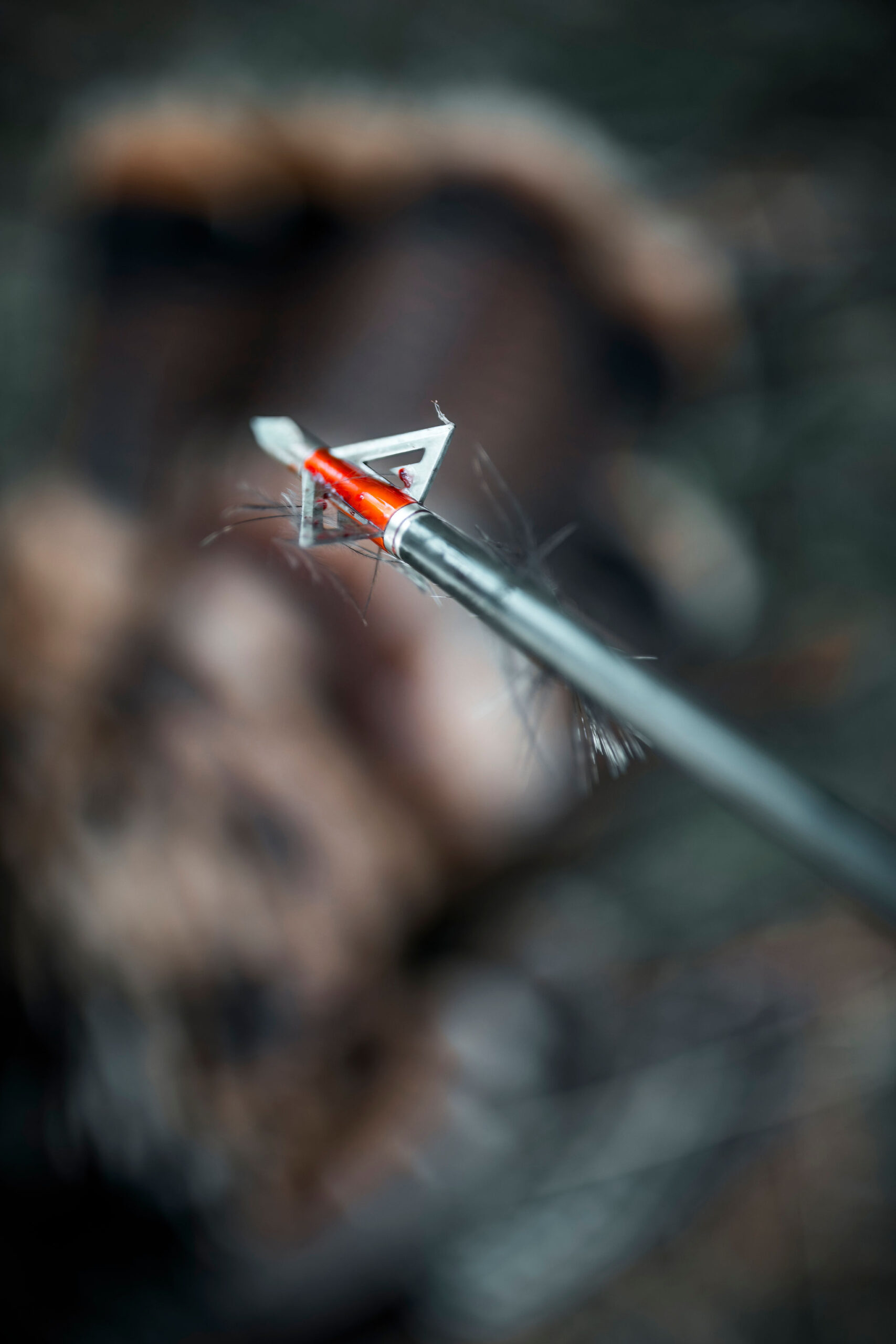
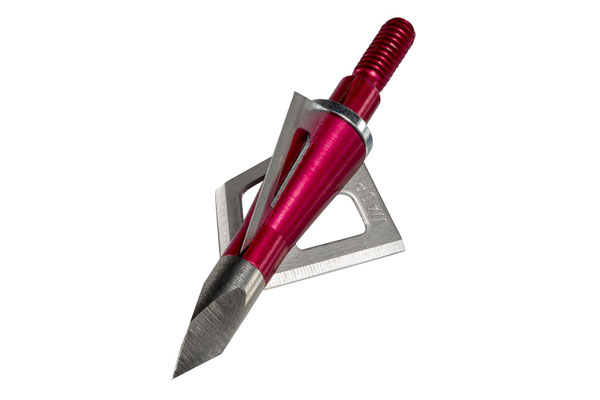
The Wasp Havalon HV is an ideal fixed-blade broadhead for turkey hunting.
There are many great reasons to use mechanical broadheads for turkey hunting, which we’ve covered extensively in previous posts. But that doesn’t mean your favorite fixed blade is useless in the spring woods. Fact is, any broadhead that’s used for whitetails and similar sized game will work just fine on gobblers. And it’s something of a misconception that penetration isn’t as important for turkey hunting. On the contrary, the feathers on these big birds are tough, and fixed-blade broadheads provide your best chance for punching through them, breaking bones, and putting two holes through the vitals for a quick, humane kill. Larger diameter 3-blade broadheads with our chisel-style Stainless Smart Tip (SST), such as our popular Wasp Havalon HV, are sharp, hard-hitting, accurate, and deadly effective for turkey hunting.
— Story and images by Wasp Archery Staff
View All Posts